



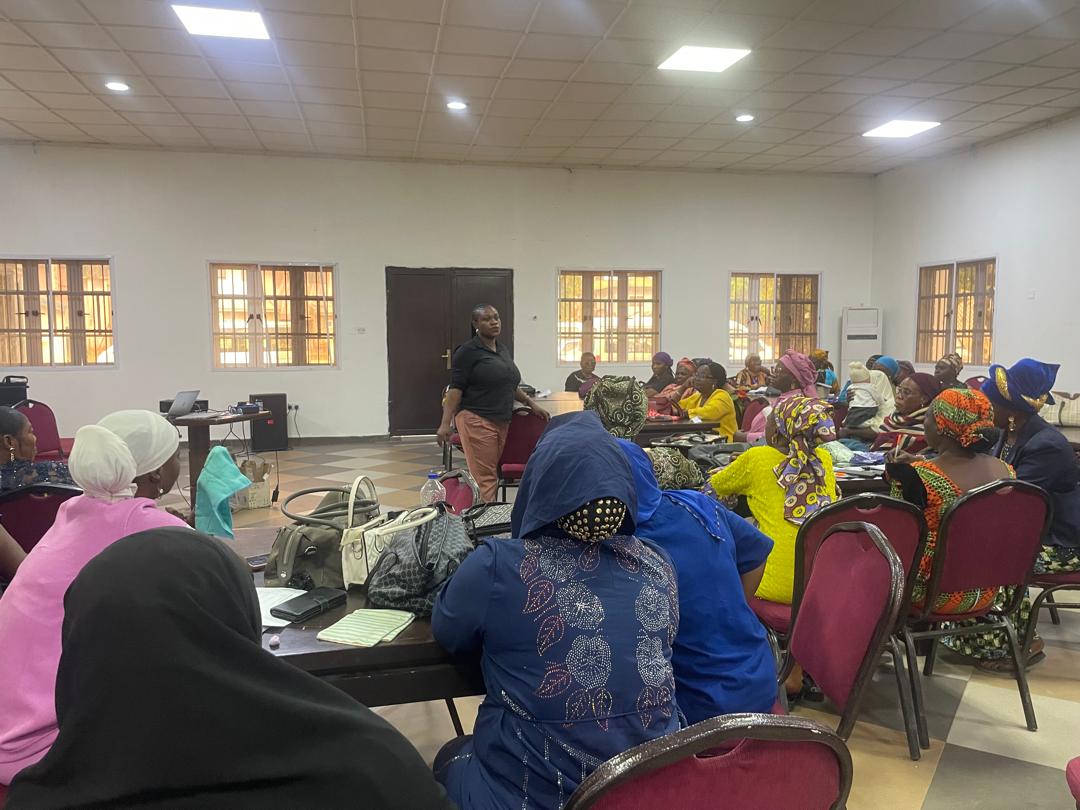
As part of efforts to strengthen primary healthcare delivery, close administrative loopholes, and scale up maternal health at primary healthcare centers in Oyo State, the Justice, Development and Peace Commission (JDPC), Ibadan, has equipped over 50 maternal health champions with structured reporting tools and feedback frameworks.
This initiative, implemented under the International Budget Partnership (IBP) International Center for Investigative Reporting (ICIR) Spark 2.3 Project, focuses heavily on maternal and primary healthcare services across select local government areas in Ibadan and Oyo State at large.

The Programme Manager for the IBP Spark Project at JDPC, Jide Bamigoshe, while speaking during the training session, explained that the intervention is designed to inject system structure and uniformity into how community champions track facility performance, rather than serving as a witch-hunt against healthcare workers.

“Over the years, they have been reporting, but we need to make it structural, more systemic in terms of having uniform tools to report their findings. After which, analysis will be carried out, and a formal presentation will be made to relevant state actors to act upon,” Bamigoshe stated.

He noted that while the state government has recorded commendable successes, including the employment of personnel, drug availability through the drug revolving fund, and the institutionalization of mandatory receipting for all transactions, various systemic gaps and out-of-pocket expenses persist at some primary healthcare centres.
He highlighted that they have been able to uncover certain challenges peculiar to selected PHCs through the reports filed in recent times, but also questioned why such continues to happen.
“Some reports show 200 women coming for antenatal care, but delivery figures drop to five or, in some cases, none. That raises questions,” he noted.
He decried out-of-pocket extortion at some of the primary healthcare centers, citing situations where standard delivery fees at PHCs, officially fixed between N5,000 and N7,000, are inflated to N20,000, and N50,000 at some PHCs.
“No system is perfect, but we continue to build on it until we get there. Out-of-pocket expenses are still there, but the government is also making an effort to curb them,” he added.
The Monitoring and Evaluation Officer for JDPC Ibadan, Deborah Olowoyo, while speaking during the program, also explained that the current phase of the Spark project strategically prioritizes female members of Ward Development Committees (WDCs) to steer maternal health advocacy across the community they reside in.
She maintained that for this project, they are working with over 50 champions spread across 6 key local government areas, training them on data collection metrics, such as antenatal care (ANC) attendance and delivery counts, family planning, and malaria, as well as deploying feedback tools to capture direct experiences from service receivers.
However, she commended the commitment of the champions, noting that female inclusion in WDCs has seen a positive shift from past years where males dominated key positions.
While speaking with newsmen during the program, Mrs.Deborah Adebayo, a participant representing WakaJaye Ward 7 Health Centre, lauded the IBP and JDPC for the opportunity, and expressed readiness to put in her best for the benefit of expectant mothers and others in the society.
“I was a mother, and I love seeing my people go to give birth and come back alive with their babies. I am very happy to accept this offer to be a maternal champion.”
Another participant, Akaju Omowunmi from Apatere Community in Lagelu Local Government, also commended the Initiators of the program, highlighting the impact of the program, with support from the JDPC team, in transforming Apatere Community Primary Healthcare from its moribund state to an actively functioning facility in recent times.