


Early Monitoring Findings Raise Concerns Over AI, Political Competition Ahead of Nigeria’s 2027 Elections – CEREDEMS

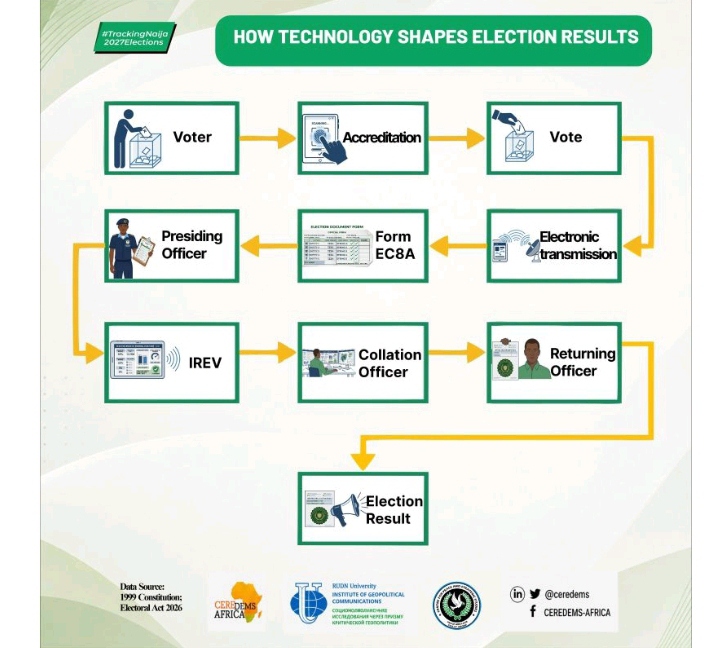
The collaborative TrackingNaija2027 Elections initiative of the Centre for Research on Development of African Media, Governance and Society (CEREDEMS-Africa), the Centre for Peace and Strategic Studies (CPSS), University of Ilorin, and the Institute of Geopolitical Communications, RUDN University, Moscow, Russia, has begun to produce evidence-based insights from its ongoing monitoring of Nigeria’s 2027 electoral environment.
The collaborative initiative which deployed a 300-member volunteer monitoring network, has moved beyond preparatory activities into systematic evidence collection and analysis, with emerging findings highlighting the changing nature of political competition, the growing role of artificial intelligence in campaign communication, weaknesses that could affect confidence in electoral technology, and the need for consistent enforcement of electoral laws.

The early findings demonstrate that Nigeria’s 2027 electoral environment is already being shaped by developments occurring well before the formal election period.

A release issued by the body notes a particularly significant finding emerging from the monitoring concerns the increasing use of artificial intelligence in political communication.

The evidence being generated by the project indicates that AI-generated content is already becoming part of the political communication environment, with monitored content showing both positive and negative applications.
According to the release, the monitoring has identified what it describes as “glowfake” content, which is deployed to glorify candidates, political parties and issues of national importance, alongside “foefake” content focused on attacking opponents or political issues. The body notes that the significance of these findings lies not merely in the production of synthetic content but in the potential for such content to shape political perceptions and deepen divisions along political orientations and ideological lines.
Based on the evidence from the tracking, AI-generated political communication suggests that the technology is becoming relevant to campaign strategy rather than remaining a peripheral digital phenomenon.
Content designed to promote candidates and parties can contribute to favourable perceptions and political mobilisation, while content designed to attack opponents can amplify negative narratives and polarisation. This makes artificial intelligence an emerging component of the electoral information environment that requires attention not only from technology specialists but also from electoral institutions, political parties, media organisations, civil society groups and citizens.
The findings therefore suggest that the integrity of the 2027 elections will increasingly depend on the ability of stakeholders to understand not only whether political content is authentic, but also how synthetic content is produced, circulated, targeted and used to influence political perceptions.
The emerging AI findings also point to a broader challenge for electoral monitoring. Traditional approaches to information integrity often focus on identifying misinformation or determining whether a particular piece of information is false.
The monitoring therefore draws attention to the need for INEC and other relevant stakeholders to strengthen technological readiness while ensuring that officials are adequately equipped and that voters and stakeholders receive sufficient information about the processes through which electoral results are the existence of legal provisions alone is insufficient to prevent electoral violence.
The monitoring consequently highlights the importance of advocacy around prohibited electoral behaviour and its consequences, while stressing that consistent enforcement can help prevent inflammatory conduct from escalating into broader electoral crises.
Conversely, the body therefore notes that consistent application of electoral law can strengthen deterrence and demonstrate that electoral rules apply to all actors. The monitoring consequently identifies enforcement not simply as a legal responsibility but as an important component of electoral risk prevention and public confidence.
Taken together, these early findings indicate that Nigeria’s 2027 electoral risks are interconnected. Increasing political competition can intensify campaign communication; increasingly sophisticated digital communication can provide political actors with new tools for persuasion and attack.
For the three partner institutions.
The early evidence provides a clear indication that the 2027 elections are already being shaped by forces extending beyond conventional campaign activities. Political competition is intensifying, artificial intelligence is entering campaign communication, digital narratives are increasingly capable of influencing political perceptions, electoral technology is becoming central to confidence in results management, and the enforcement of electoral rules remains critical to preventing political behaviour from escalating into electoral violence.
These developments demonstrate why electoral monitoring must begin long before election day and why evidence must be continuously transformed into public understanding and preventive action.