

Oyo 2027: Why Adekanmbi Must Answer Questions Over Makinde’s Record || David Oluokun


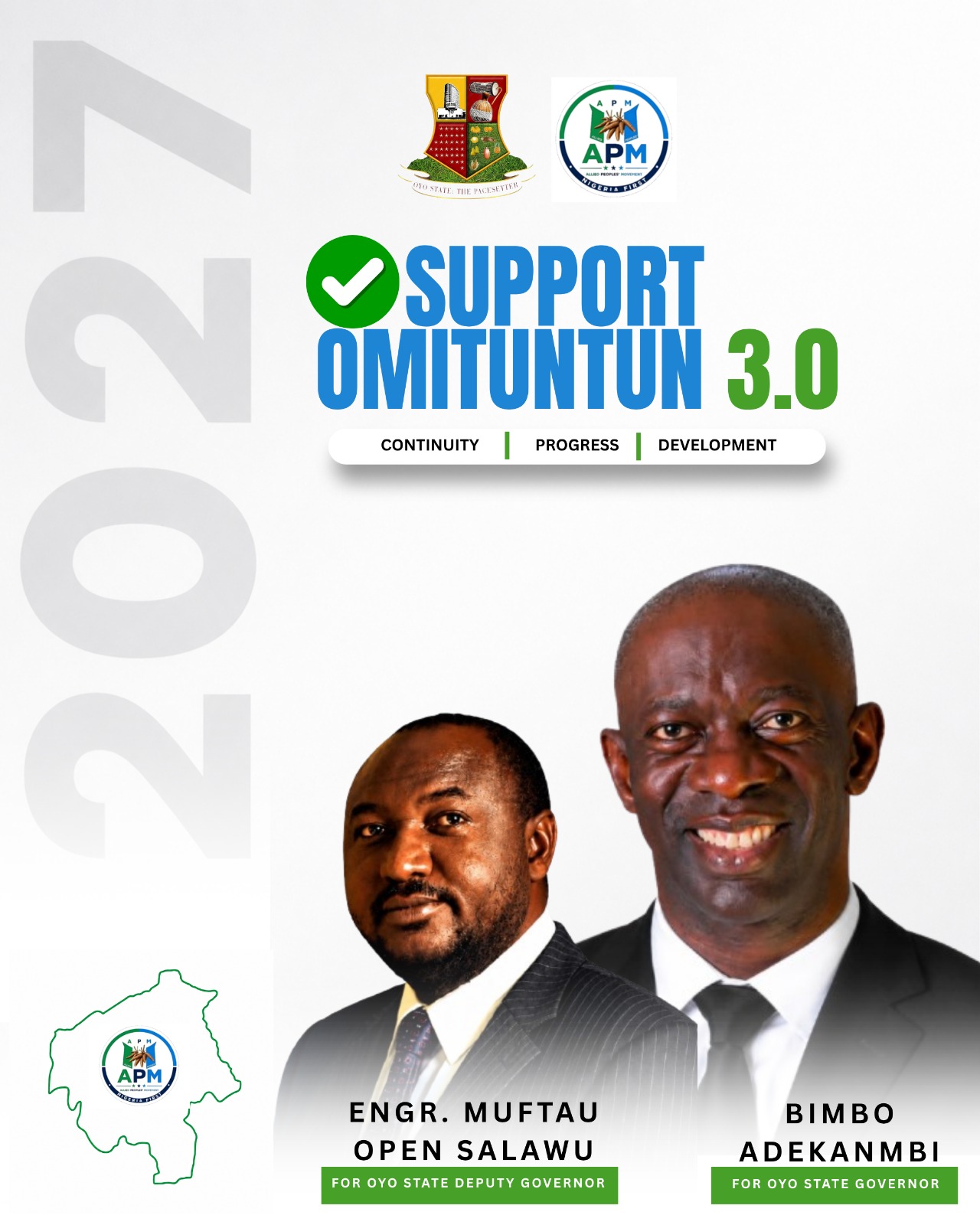
As the 2027 governorship election in Oyo State gradually gathers momentum, the political contest is increasingly becoming a referendum on the performance of the incumbent administration and the credibility of those seeking to succeed it. At the centre of this emerging debate is Bimbo Adekanmbi, the governorship candidate of the Allied Party Movement (APM), whose political association with Governor Seyi Makinde has become a subject of intense scrutiny among opposition figures.
Adekanmbi’s recent remarks concerning Senator Sharafadeen Abiodun Alli (BSA) on Fresh FM, Ibadan, have further intensified the political exchanges. While the precise substance of those remarks deserves to be examined on its merits, the more fundamental question is whether Adekanmbi can convincingly establish himself as an independent political alternative rather than a continuation of the incumbent administration by another name.

For a state as politically conscious and historically significant as Oyo, the question of succession cannot be reduced to personality clashes, media exchanges or partisan rhetoric. It must necessarily revolve around governance, accountability, institutional independence and the future of its people.
## The Burden of Political Association

One of the most consequential challenges confronting Adekanmbi is the perception that his candidacy represents an attempt to preserve Makinde’s political influence beyond the constitutionally permitted tenure of the incumbent governor.
His critics contend that his emergence is closely associated with the governor and that an Adekanmbi administration could sustain the policies, political arrangements and governing practices of the outgoing administration.
Such allegations are politically significant, but they must ultimately be tested against verifiable evidence, the candidate’s public record and the policy commitments he presents to the electorate.
Adekanmbi, therefore, has a responsibility to demonstrate that he possesses the political independence, administrative competence and intellectual capacity required to govern Oyo State. He must explain, in clear and unambiguous terms, where he agrees with the present administration, where he intends to depart from its policies and how his proposed government would address the concerns of ordinary citizens.
The governorship of Oyo State is too consequential to be treated as an instrument for settling political scores or preserving the influence of any individual.
## Local Government Autonomy and the Test of Institutional Independence
The controversy surrounding local government autonomy remains one of the critical issues against which the political credentials of prospective successors to Makinde will be assessed.
Following the Supreme Court’s landmark judgment on local government financial autonomy in July 2024, the debate over the independence of the third tier of government has assumed renewed national importance.
For Oyo State, the relevant question is whether the next administration will strengthen democratically elected local councils, respect their constitutional responsibilities and ensure that resources allocated to them translate into tangible development at the grassroots.
Adekanmbi must clarify his position on this matter. Will his administration promote institutional independence and accountable local governance, or will it preserve arrangements that critics consider inimical to the autonomy of local councils?
These are not peripheral questions. They concern the provision of primary healthcare, rural roads, markets, sanitation, community security and other services that directly affect residents across the state’s 33 local government areas.
The electorate deserves a clear answer rather than another round of partisan exchanges.
## Markets, Agriculture and the Livelihood of Ordinary Citizens
The condition of public markets and the management of agricultural resources are equally important components of the debate over Makinde’s legacy.
Critics of the incumbent administration have raised concerns about the conversion of spaces previously used for parking, sanitation and other essential market facilities into commercial structures in parts of the state, including the Gbagi market axis.
The allegations, including claims concerning the sale of shops and the consequences for traders and customers, require a transparent examination of the relevant transactions, planning approvals and the circumstances surrounding the reported changes.
Markets are not merely commercial properties from which governments can generate revenue. They are essential economic institutions whose accessibility, sanitation, security and infrastructure determine the survival of thousands of small businesses.
Any administration seeking to succeed Makinde must explain how it intends to protect traders, improve market infrastructure and ensure that commercial development does not undermine the economic interests of ordinary citizens.
Agriculture presents a similarly important test. Allegations have also been raised concerning tractors acquired during the administration of the late former governor Abiola Ajimobi and their subsequent disposal under the present government.
If established, the circumstances surrounding the disposal of publicly acquired agricultural equipment would warrant a thorough explanation. The public deserves to know the assets involved, the basis for their disposal and whether the state received appropriate value.
At a time when food affordability and agricultural productivity remain major public concerns, the next administration must demonstrate a credible commitment to supporting farmers, improving mechanisation and strengthening food production.
Adekanmbi should use the opportunity to articulate his agricultural policy rather than allow the debate to be dominated by accusations and counter-accusations.
## Public Debt and the Question of Value for Money
The management of public finances will also feature prominently in the 2027 electoral contest.
Makinde’s administration has faced political criticism over borrowing, the implementation of capital projects and the extent to which public expenditure has improved the living conditions of residents.
Among the projects cited by critics are the Agbowo Shopping Complex and certain developments associated with the Ladoke Akintola University of Technology (LAUTECH). The status, funding arrangements and progress of the projects should be assessed through official records rather than partisan characterisation.
Nevertheless, the broader question remains legitimate: what measurable economic and social benefits have accrued to Oyo residents from the state’s borrowing and expenditure decisions?
Public debt is not inherently evidence of administrative failure. Borrowing can finance infrastructure, stimulate economic activity and expand public services when it is undertaken prudently and supported by sustainable repayment arrangements.
The real test is whether borrowed funds are transparently managed, projects are completed within reasonable timelines and the resulting assets generate sufficient public value to justify the financial obligations incurred.
Adekanmbi must therefore explain how he would manage the state’s fiscal position, strengthen revenue generation, prioritise capital expenditure and prevent public liabilities from becoming an excessive burden on future generations.
A credible succession plan should be built on fiscal transparency and measurable outcomes, not merely on the rejection or defence of an incumbent governor’s record.
## The Political Implications of the Fresh FM Exchange
Adekanmbi’s reported remarks concerning Senator Alli on Fresh FM have provided another platform for political contestation ahead of the election. However, the significance of the exchange extends beyond the immediate personalities involved.
In a democracy, political candidates are entitled to criticise one another, challenge opposing policy positions and defend their records. Such exchanges become more meaningful when they are supported by evidence and accompanied by practical alternatives.
If Adekanmbi believes that Alli’s position or political record deserves criticism, he should substantiate his claims and explain how his own proposals would produce better outcomes for the state. Equally, those defending Alli must be prepared to subject his political commitments and policy positions to public scrutiny.
The electorate gains little from allegations that are neither substantiated nor answered with credible evidence.
What matters is whether candidates can demonstrate a sound understanding of Oyo State’s economic challenges, propose workable solutions and submit themselves to the discipline of public accountability.
## Why the Electorate May Reject Continuity
The 2027 election will offer Oyo voters an opportunity to assess the incumbent administration’s record and determine the direction in which the state should proceed.
For Adekanmbi, the challenge is particularly demanding because his political association with Makinde makes it difficult to separate his candidacy from the wider debate about the governor’s legacy.
If he intends to persuade voters that he represents a genuinely different political proposition, he must do more than distance himself rhetorically from his critics. He must present an identifiable programme of governance, demonstrate independence of judgment and explain how his administration would address the issues of public finance, market development, agricultural productivity, local government autonomy and infrastructure delivery.
The opposition, on its part, must recognise that electoral credibility is not established by denunciation alone. Candidates seeking to replace an incumbent administration must convince voters that they possess both the competence to govern and a practical plan for delivering better results.
For the people of Oyo State, the ultimate question is not simply whether Adekanmbi is associated with Makinde or whether Senator Alli is the preferred alternative. It is which candidate can best protect public resources, strengthen democratic institutions and improve the material conditions of the population.
## The Verdict Belongs to Oyo Voters
The outcome of the 2027 governorship election cannot responsibly be declared in advance. No political party or candidate has an automatic entitlement to victory, and no electorate should be presumed to have reached a unanimous conclusion before the ballot is cast.
What can be said with certainty is that voters have legitimate grounds to demand answers from every candidate seeking the highest political office in the state.
Adekanmbi must explain what distinguishes his proposed administration from Makinde’s, particularly on the contentious issues that have shaped public debate. Alli and other contenders must equally demonstrate the credibility, competence and policy depth required to govern.
Ultimately, Oyo voters will make their choice on the strength of the arguments presented, the credibility of the candidates and their assessment of the state’s experience under the present administration.
If Adekanmbi fails to convince the electorate that he can offer an independent and demonstrably better alternative, the burden of association with Makinde’s record could become a formidable electoral liability.
In 2027, the decisive question will not be who can deliver the sharpest political attack on the radio. It will be who can persuade the people of Oyo State that their future will be better served by the government they elect.