


Abdul-Hameed Unpacks NELFUND, Academic Stability and Education Reform
By Samson Oladejo

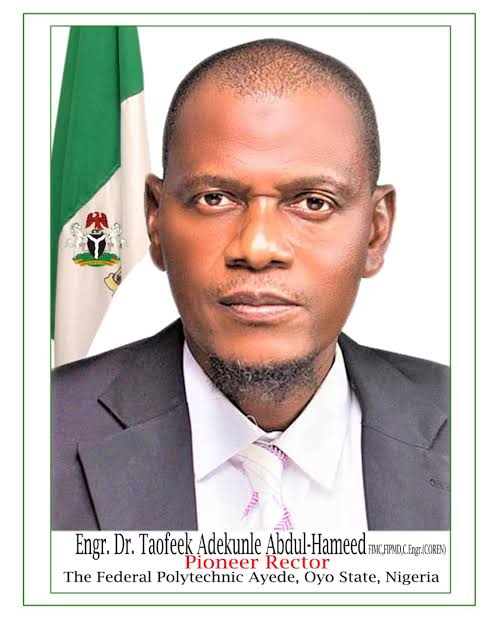
Nigeria’s tertiary education reform agenda has received a fresh intellectual and professional assessment as the Pioneer and Immediate Past Rector of Federal Polytechnic Ayede, Oyo State, Engr. Dr. Taofeek Adekunle Abdul-Hameed, FNSE, presented an analytical review of the Federal Government’s interventions in student financing and academic stability.
Dr. Abdul-Hameed delivered the presentation on Wednesday, September 23, 2026, at the Three-Year Administration Review and Book Presentation organised by Better Nigeria in Practice of Good Conduct at the Shehu Musa Yar’adua Centre, Central Business District, Abuja.

Speaking on “The Tinubu Administration’s Reform of Tertiary Education in Nigeria: A Focus on NELFUND and the Pursuit of Stable Academic Calendars,” the seasoned engineer, scholar and education administrator examined two major areas of tertiary education reform — access to education through the Nigerian Education Loan Fund (NELFUND) and efforts to address the recurrent disruption of academic calendars arising from industrial disputes.

With a career spanning engineering, technology management, academic administration and polytechnic education, Dr. Abdul-Hameed brought to the discourse a perspective shaped by both scholarship and practical institutional leadership.

His academic credentials include degrees in Electrical Engineering, Industrial and Production Engineering, Technology Management and doctoral qualifications in Technology Management and Electrical/Electronic Engineering. The Federal Polytechnic Ayede profile also records his extensive experience in engineering education, quality assurance, accreditation exercises and institutional administration.
NELFUND: FROM POLICY TO MEASURABLE IMPACT
Dr. Abdul-Hameed described student financing as one of the critical dimensions of tertiary education reform, noting that financial constraints have historically prevented many Nigerian youths from accessing or completing higher education.
He observed that the establishment and expansion of NELFUND represented an important policy development that deserved careful assessment through measurable outcomes.
According to the latest figures available as of September 3, 2026, NELFUND had processed 1,659,853 applications, with total disbursements reaching ₦355.87 billion. Of this amount, ₦192.89 billion had been paid to 319 beneficiary institutions as institutional fees, while ₦162.98 billion had been disbursed as student upkeep allowances.
Dr. Abdul-Hameed said the figures demonstrated the scale at which student financing had expanded, while stressing the importance of sustained implementation, transparency and effective monitoring.
“NELFUND and the effort to end the ASUU crisis are two sides of one vision: putting the Nigerian student at the centre of national development,” he stated.
He explained that student loans address the financial barrier to entering and remaining in tertiary education, while stable academic calendars address the institutional barrier to completing programmes within reasonable periods.
FEDERAL POLYTECHNIC AYEDE: A PRACTICAL CASE STUDY
Drawing from his experience as the Pioneer Rector of Federal Polytechnic Ayede, Dr. Abdul-Hameed demonstrated how national education policies could translate into direct interventions at institutional level.
He disclosed that in March 2025, NELFUND paid the full tuition fees of 44 students of Federal Polytechnic Ayede directly to the institution, after which the pioneer beneficiaries began receiving monthly upkeep allowances.
He noted that the intervention was particularly significant for a young institution such as Federal Polytechnic Ayede, which was established in 2021 and had to build its academic and administrative structures from the ground up.
“For us at Federal Polytechnic Ayede, the impact of NELFUND is not abstract — it is real, direct and life-changing,” he said.
He further explained that the institution’s management had prioritised verification, data submission, sensitisation and counselling to ensure that eligible students were positioned to benefit from the scheme.
“What we are witnessing is a reflection of purposeful governance — an administration that has backed its commitment to education with real, measurable action,” Abdul-Hameed stated.
FROM INDUSTRIAL CONFRONTATION TO STRUCTURED DIALOGUE
Turning to the second focus of his presentation, the former Rector examined efforts to achieve greater stability in Nigeria’s university academic calendar.
He recalled the devastating impact of prolonged industrial disputes on students, institutions and the national education system, noting that prolonged strikes could transform programmes designed to last four years into significantly longer academic journeys.
Dr. Abdul-Hameed highlighted the December 2025 Federal Government–Academic Staff Union of Universities (ASUU) agreement as a significant development in the attempt to establish a more structured relationship between government and university-based academic unions.
He drew attention to provisions concerning academic remuneration, allowances, research funding, institutional autonomy and broader engagement with tertiary education unions.
However, consistent with his call for evidence-based assessment, the education administrator also cautioned against treating agreements as the end of the reform process.
“The December 2025 agreement was a genuine structural breakthrough, but its durability still depends on continued, faithful implementation rather than being a fully closed chapter,” he cautioned.
He therefore advocated sustained dialogue, responsible funding and institutional accountability as essential ingredients for maintaining academic stability.
A SCHOLAR’S CALL FOR SUSTAINABILITY
Dr. Abdul-Hameed emphasised that the ultimate measure of tertiary education reform should not merely be the announcement of policies but their ability to produce lasting improvements in the lives of Nigerian students, lecturers and institutions.
“One removes the financial barrier to entry; the other aims to remove the systemic barrier to completion,” he said of NELFUND and the efforts toward academic stability.
He further stated that the objective should be to create an education system where students can commence their programmes without debilitating financial barriers and complete them without recurrent disruptions.
“If sustained and fully implemented, these reforms can move Nigeria toward an era where a four-year course is truly four years, where no youth is denied education because of poverty, and where lecturers are motivated to stay and build the nation,” he said.
ABDUL-HAMEED’S NATIONAL EDUCATION LEGACY
The Abuja presentation further placed Dr. Abdul-Hameed’s contribution to Nigeria’s tertiary education conversation beyond the confines of Federal Polytechnic Ayede.
As the Pioneer Rector of the institution, he was instrumental in leading a young federal polytechnic through its formative years. The institution’s official records identify him as its Pioneer Rector and document his extensive background in engineering education, accreditation, quality assurance, academic administration and professional development.
Under his leadership, Federal Polytechnic Ayede also publicly articulated an ambition to develop into a competitive institution in academic programmes, infrastructure and international visibility.
His interventions on technical education have equally extended to issues such as skills acquisition, entrepreneurship, employability and the future of polytechnic education. In 2025, he publicly advocated reforms to the longstanding HND/BSc dichotomy and called for greater recognition of the technical and practical orientation of polytechnic education.
These experiences have positioned the engineer, scholar and former Rector as a voice with practical experience in the challenges confronting Nigeria’s tertiary education system.
A MESSAGE FOR THE FUTURE
Concluding his presentation, Dr. Abdul-Hameed stressed that education reform must remain a continuous national project requiring consistency, accountability and collaboration among government, institutions, unions, students and other stakeholders.
His message was anchored on a simple principle: the Nigerian student must remain at the centre of tertiary education policy.
For Federal Polytechnic Ayede, his Abuja intervention represents another chapter in the continuing record of a pioneer administrator whose professional career has combined engineering, technology, education, institutional development and national policy discourse.
As Nigeria continues to examine the effectiveness and sustainability of its tertiary education reforms, Dr. Abdul-Hameed’s intervention adds the perspective of an experienced education administrator who has witnessed the challenges of Nigerian tertiary education not merely from the conference room, but from the front line of institution-building.
Engr. Dr. Taofeek Adekunle Abdul-Hameed, FNSE, FNIEEE, FIMC, FIPMD, IION — engineer, scholar, education administrator and Pioneer/Immediate Past Rector of Federal Polytechnic Ayede — continues to contribute his professional experience to the national conversation on building a more accessible, stable, skills-oriented and globally competitive Nigerian tertiary education system.