



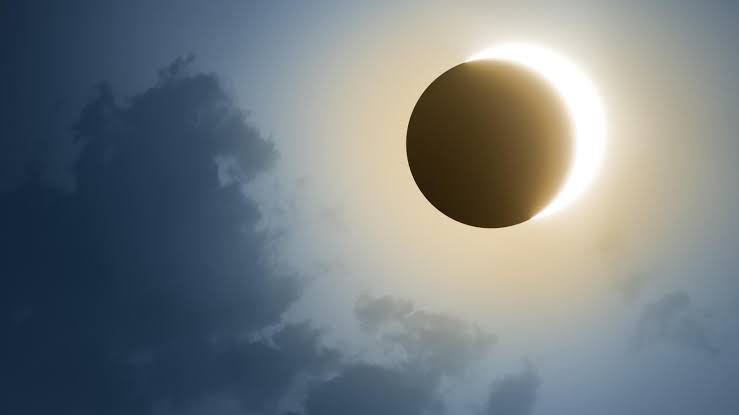
Parts of the world are set to witness a rare celestial event on August 12, 2026, when the moon moves directly between the earth and the sun. In some places, the moon will completely cover the sun for less than two minutes, creating an occurrence called total solar eclipse.
According to the National Aeronautics and Space Administration (NASA), the eclipse will be visible across parts of Europe, Greenland, Iceland, Russia, North America, and Africa, although what people see will depend on where they are.

From what a solar eclipse is to the different types, where the August 12 eclipse will be visible, and how to watch it safely, here are the key things to know about the August 12 eclipse.

WHAT IS A SOLAR ECLIPSE?

A solar eclipse is a celestial event that occurs when the sun, the moon, and the earth align, with the moon passing directly between the earth and the sun. As the moon moves across the sun, it blocks some or all of the sun’s light from reaching the earth, causing the sky to darken.
The type of eclipse people see depends on where they are. In some places, the moon completely covers the sun, while in others, it covers only part of it.
There are four types of solar eclipses: total, partial, annular, and hybrid.
A total solar eclipse occurs when the moon completely covers the sun, briefly turning day into darkness. This is the rarest and most dramatic type of eclipse because the sun’s bright surface is entirely hidden for a short period.
A partial solar eclipse occurs when the moon covers only part of the sun. Instead of disappearing completely, the sun looks like a small piece has been taken out of it. The moon never fully covers the sun during a partial solar eclipse.
An annular solar eclipse occurs when the moon is farther away from the earth and appears slightly smaller than the sun. As a result, it cannot completely cover the sun, leaving a bright ring of sunlight, often called the “ring of fire,” visible around the moon.
A hybrid solar eclipse is the rarest type of solar eclipse. It appears as a total solar eclipse in some places and an annular solar eclipse in others, depending on where it is viewed from.
However, the August 12, 2026 solar eclipse will feature a total solar eclipse in some parts of the world and a partial solar eclipse in others.
WHERE WILL AUGUST 12 ECLIPSE BE VISIBLE?
According to NASA, the August 12, 2026 solar eclipse will be visible across parts of Europe, North America, Africa, Greenland, Iceland, and Russia. However, what people see will depend on where they are.
Total solar eclipse
A total solar eclipse will be visible only in a narrow stretch that passes through northern Russia, Greenland, Iceland, and parts of northern Spain.
People in these locations will first see the moon gradually move across the sun, creating a partial eclipse. After about an hour, the moon will completely cover the sun, creating a total solar eclipse. The sky will become dark for a short time before the sun slowly reappears as the moon moves away.
Although the entire eclipse will last for around one and a half to two hours, the period when the sun is completely covered, known as totality, will last for less than two and a half minutes.
Partial solar eclipse
People outside the areas where the moon completely covers the sun will experience only a partial solar eclipse, during which the moon blocks only part of the sun.
The partial eclipse will be visible across much of Europe, parts of North America, and northwestern Africa, including Morocco, Algeria, and Senegal.
However, the amount of the sun covered will vary depending on the location.
For instance, in Dakar, Senegal, the moon will cover up to 37% of the sun, making it appear as though a small portion is missing. While London will experience up to 91% coverage, leaving only a thin part of the sun visible.
WHY WILL SOME PLACES EXPERIENCE A TOTAL SOLAR ECLIPSE WHILE OTHERS PARTIAL?
When the moon passes between the earth and the sun, it casts a shadow on the earth that is only about 300 miles (480 kilometres) wide. This shadow has two parts: the umbra and the penumbra.
The umbra is the darkest part of the shadow, where the moon completely blocks the sun, causing a total solar eclipse. The penumbra is the lighter outer part of the shadow, where the moon blocks only part of the sun, resulting in a partial solar eclipse.
This is why the August 12, 2026 eclipse will appear differently around the world.
People in the umbra will experience a total solar eclipse, while those in the penumbra will see only a partial solar eclipse.
HOW CAN THE SOLAR ECLIPSE BE VIEWED?
Watching a solar eclipse requires proper eye protection, as looking directly at the sun without it can cause serious and permanent eye damage.
According to NASA, it is never safe to look directly at the sun during a partial solar eclipse without certified eclipse glasses or a handheld solar viewer. This is because part of the sun remains visible throughout the event, and its rays are still harmful.
People in places where the total solar eclipse will be visible can remove their eclipse glasses only during totality, the brief period when the moon completely covers the sun. Once the sun begins to reappear, they must put their eclipse glasses back on immediately before looking at it again.
Those who do not have eclipse glasses can watch the event indirectly using methods such as a pinhole projector, which projects an image of the eclipse onto a surface without requiring people to look directly at the sun.
However, ordinary sunglasses, cameras, binoculars, telescopes, or phone cameras should not be used to look at the eclipse.
HAS NIGERIA EVER WITNESSED A SOLAR ECLIPSE?
Yes. Nigeria has witnessed a total solar eclipse before.
The recent one was a total solar eclipse on March 29, 2006, when the moon completely covered the sun for about four minutes.
The eclipse was visible in several states, including Benue, Katsina, Zamfara, Jigawa, and Oyo.
Nigeria’s next total solar eclipse is expected on March 20, 2034. Before then, the country will experience another solar eclipse on February 6, 2027.
On that day, Nigerians will witness either an annular or a partial solar eclipse, depending on their location. Those within the path of annularity will see an annular solar eclipse, where the moon leaves a bright ring of sunlight visible around it. People outside that path will witness only a partial solar eclipse, with the moon covering only part of the sun.
TheCable